 Wisbid
The Wisbid blog
Overdue Maintenance Jobs: A Practical Backlog Review for Property Managers
Turn a list of open maintenance jobs into clear priorities, owners and next actions.

A long list of open maintenance jobs does not tell a property manager what to do next. Some work may be ready to schedule; another job may be waiting for access, an approved quotation or a safety decision. A useful backlog review separates those cases and gives each one an owner.
Start with risk, not the oldest date
Review reports of immediate danger or loss of an essential service through your organisation's emergency procedures first. For the remaining jobs, consider the asset, the consequences of delay, who may be affected and the information available. A cosmetic defect and a fault affecting a critical system should not receive the same priority just because they were reported on the same day. Use the site's maintenance requirements and qualified advice when deciding what is safe.
As one example, NASA's facilities maintenance guidance considers safety and operational impact when deciding whether work can be deferred. It is a management example, not a rule for Singapore sites; use your organisation's own requirements.
Separate priority from readiness
A high-priority task can still be impossible to perform today. Record what is preventing work: an inaccessible area, a missing part, a contractor quotation, a permit or an approval. Assign someone to resolve that dependency and set a date to review it. For work that can proceed, identify the person or contractor and agree a realistic attendance window.
Check the record before closing a job
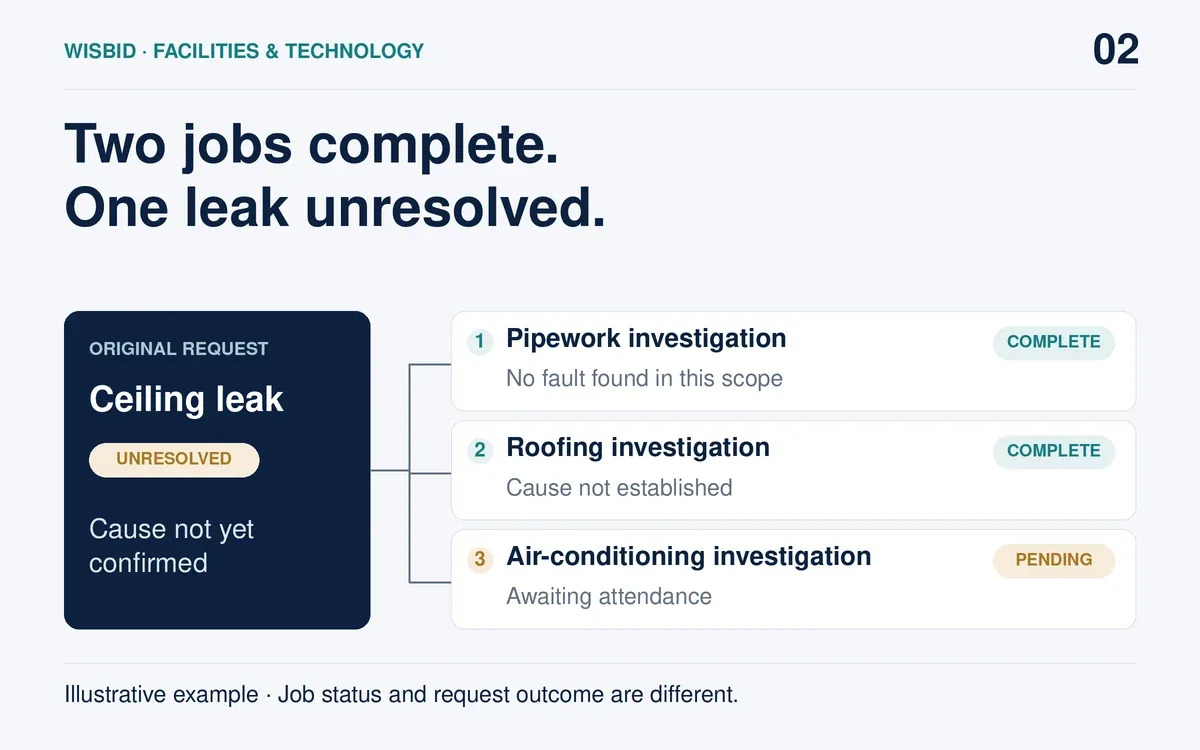
A completed visit is not always a completed repair. Ask what was inspected, what work was done and whether a follow-up is needed. Keep the date, asset or location, relevant report and the person responsible for the next step together. If a contractor attended but the cause remains uncertain, record the outstanding investigation instead of closing the underlying issue as fixed.
Use a short weekly review
For each open item, record the location or asset, risk or impact, current status, blocker, owner and next action date. Check overdue preventive tasks separately from new reactive requests. Escalate unresolved safety concerns under the site's procedures, and review repeated faults for a possible underlying problem rather than treating every report in isolation.
For example, a leak report may be awaiting access to an upstairs unit. The next action is to arrange access and agree who follows up, while recording any temporary measures already approved. If the visit identifies a separate repair, track that work and its approval rather than assuming the original report is resolved.
Make the list useful to the next person
At handover, share the decisions and evidence as well as the open count. A colleague should be able to see what is waiting, why, who owns it and when it will be reviewed. Wisbid offers property and facilities software for managing maintenance and related records. Ask the team how it would fit your existing process before choosing a workflow.
See Wisbid's maintenance platform for how work orders, ownership and closure evidence can be brought together.